|
Mehul Menon
Aligning robots to physics and people with search and learning — MS Robotics, CMU
I'm an M.S. in Robotics student at the Robotics Institute, Carnegie Mellon University, advised by Changliu Liu and Jiaoyang Li.
Before CMU, I earned a B.Tech in Mechanical Engineering from NIT Durgapur and did research with Guillaume Sartoretti at the MarMot Lab, National University of Singapore, the Centre for Non-Destructive Evaluation, IIT Madras, the PRISMA Lab at the University of Naples Federico II, and the Stoch Lab at the Indian Institute of Science.
Email
CV
Scholar
X
LinkedIn
GitHub
|

|
Research
Language models align to people through text, offline, where mistakes can be undone. Robots have to align through behavior, in real time and under physics, where often they can't.
I want robots that take an under-specified goal in an unfamiliar setting (“build me a bridge,” “help me cook”) and find a plan that physics will allow and the person actually wanted. When they can't do both, they should know it, and choose to act, abstain, or ask. My work answers to two referees. Physics: structures stand, grasps hold, and plans survive real dynamics. People: intent has to be inferred from behavior, online, from a partner who adapts back, with far too little data to learn it the way language models do. I pursue this along three threads:
- Learning to search. Learned models propose and prune while structured search keeps plans feasible, as in long-horizon LEGO assembly.
- Planning over semantics. Reasoning at the level people specify goals, such as inferring a teammate's strategy and planning around it.
- Calibrated guarantees. Embodied preference data will never be internet-scale, so calibration has to stand in for scale: knowing when it is safe to act, when to abstain, and when one more question is worth asking.
|
News
- Oct 2026 Presented a preliminary version of our intent-clarification work, Calibrated Clarification: A Computational Maxim of Quantity for Grounding Under-Specified Human Intent, at the IROS 2026 Workshop on Human–Robot Dialogue.
- Sep 2026 Preparing manuscripts on learned assembly planning, intent clarification for physical builds, and trustworthy safety guarantees for legged robots.
- Sep 2026 Submitted Latent Strategies for Ad-Hoc Human–Robot Teaming in Overcooked-AI for review.
- Jul 2026 Presented Deep Learning-Based Classification of Lubricating Oils Using Ultrasonic Waveguide Sensors at MFPT 2026.
- Mar 2026 Presented a poster at the CMU Robotics Innovation Center opening ceremony.
- Jan 2026 A Hybrid Model-based and Data-based Approach Developed for a Prosthetic Hand Wrist is on arXiv.
- 2025 Adaptive Sliding Mode Control Law Based on Super Twisting Algorithm for Trajectory Tracking of Quadrotors published in the International Journal of Automation and Control.
- Aug 2025 Started the MSR program at the CMU Robotics Institute, working with Changliu Liu and Jiaoyang Li.
- Oct 2024 Presented Design, Modelling, and Experimental Validation of a Soft Continuum Wrist Section Developed for a Prosthetic Hand at IROS 2024.
- May 2024 Graduated with a B.Tech in Mechanical Engineering from NIT Durgapur, then continued research in parallel at the Centre for Non-Destructive Evaluation, IIT Madras, and the MarMot Lab, National University of Singapore.
[show more]
|
Ongoing work
Preprints landing soon — happy to talk details before then.
|
|
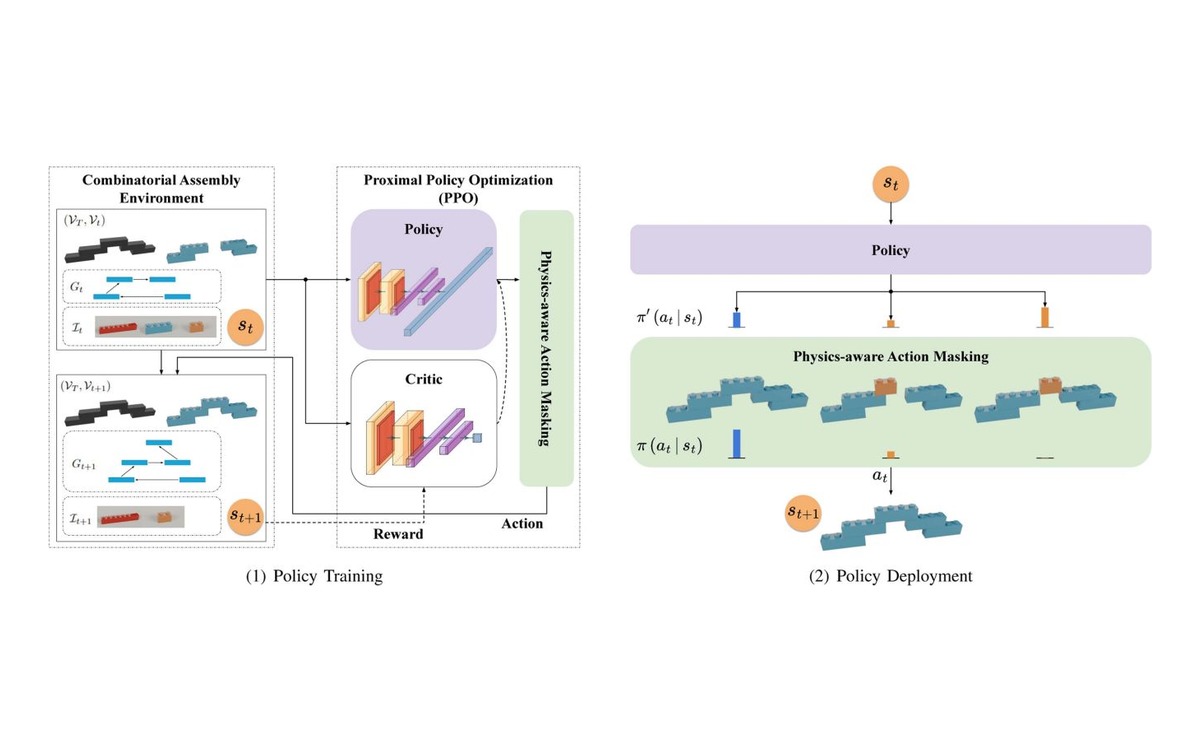
Learned guidance for physically constrained assembly
Preprint coming soon
Every hard instance solved, and about a dozen policies generalize to ~200 structures they never trained on.
Long-horizon assembly fails on the order of placements, not the choice of parts. A lightweight learned proposer steers a planner that never violates physics, cracking instances where hour-long search gives up, at a fraction of the compute.
Ask me about it →
|
|
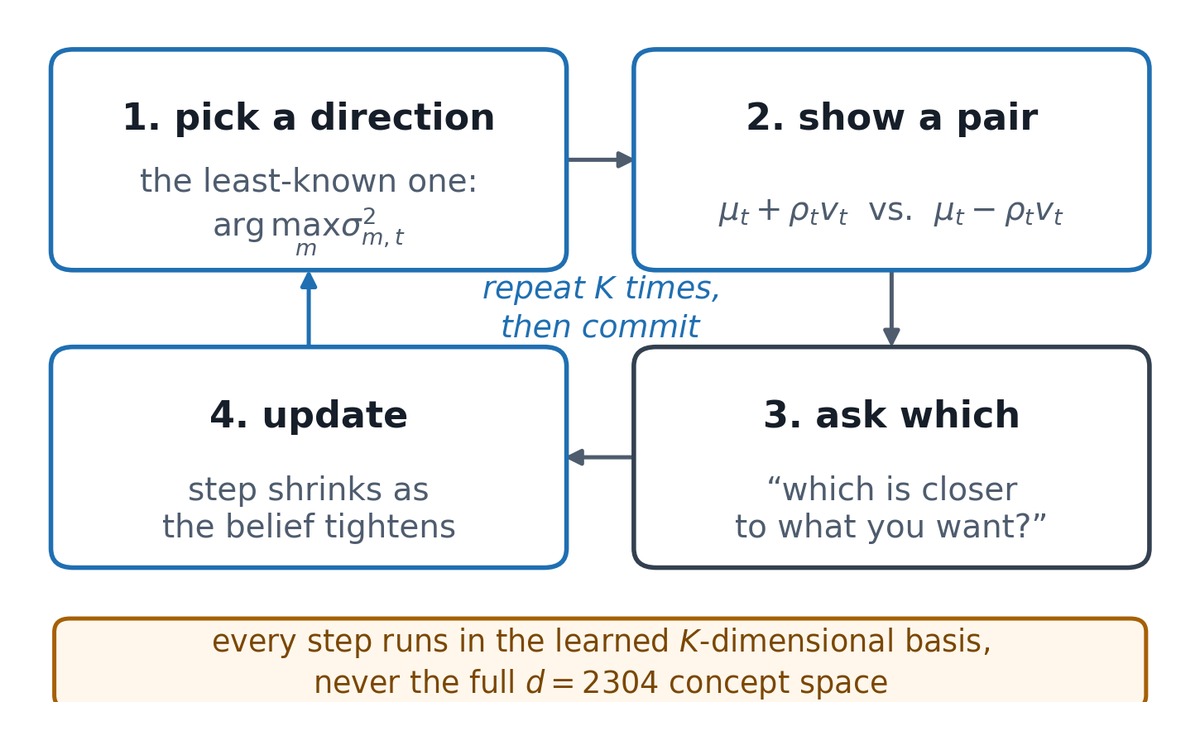
Grounding under-specified intent for physical builds
Preprint coming soon
From 1-in-10 to 9-in-10: a few simple questions turn a text-to-LEGO generator into one that builds what you actually meant.
A prompt names a category, not the design in your head, and most generated builds can't even stand. We show why interactive clarification quietly breaks in high-dimensional design spaces, and fix it with a better-posed question and a learned representation of intent.
Ask me about it →
|
|
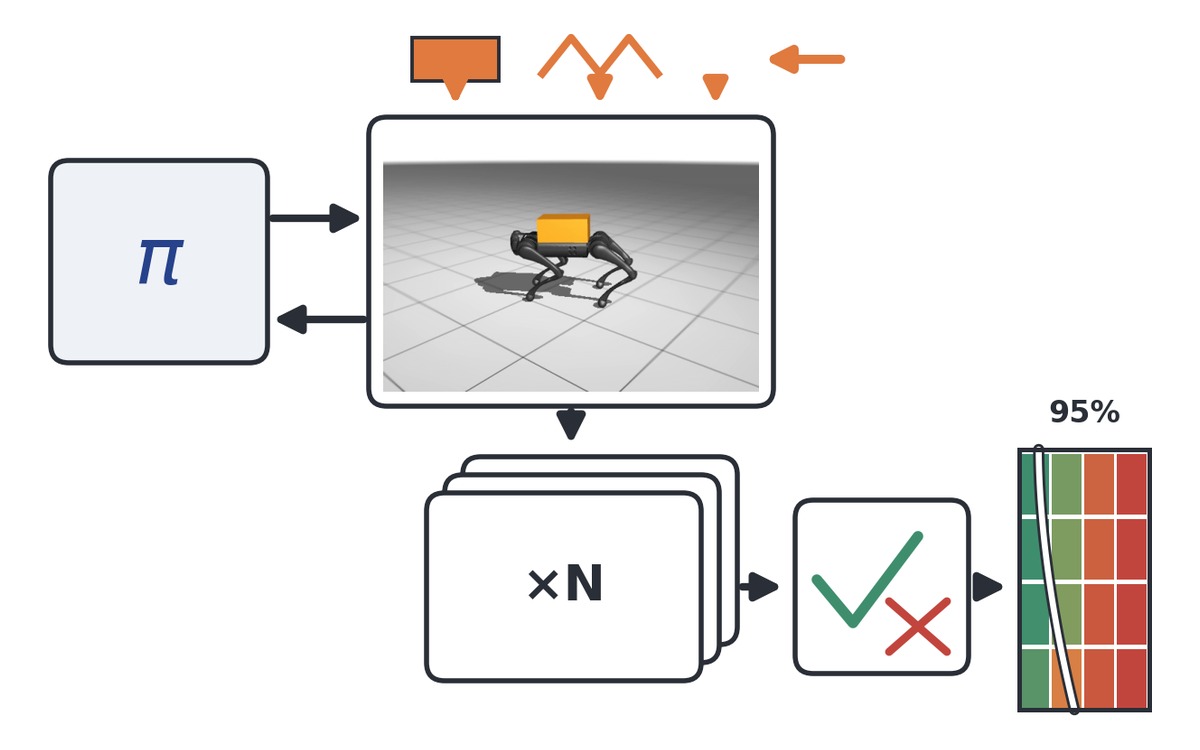
Statistical safety guarantees for learned legged control
Preprint coming soon
Zero false “safe” calls — plus a surprising finding about where a safety filter should not act on a walking robot.
Simulation makes it cheap to measure how often a learned legged policy recovers from pushes and payloads. We ask what such statistical guarantees are actually good for, and turn them into decisions about maneuvers the robot has never been tested on. In collaboration with the MarMot Lab, National University of Singapore.
Ask me about it →
|
|
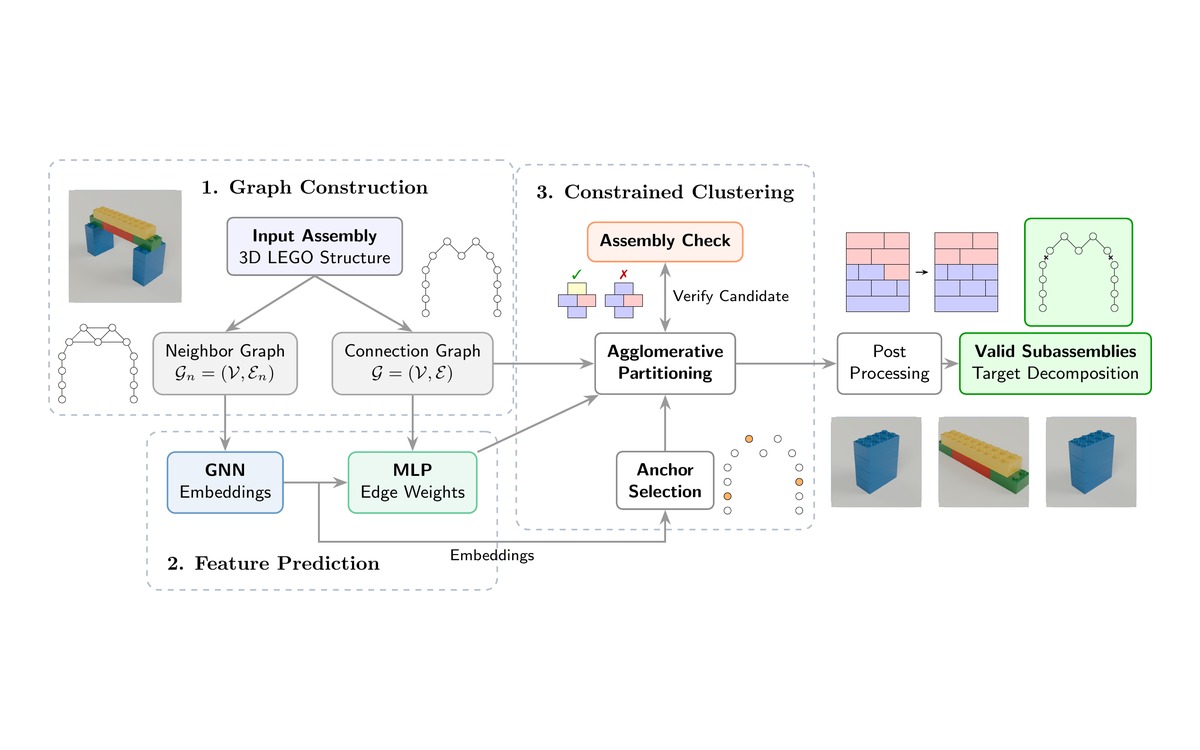
Splitting large assemblies for multi-robot builds
Preprint coming soon
Every part it hands a robot is guaranteed to stand on its own.
Big brick models have to be split into pieces that separate robots can build in parallel. We pair learned graph features with a partitioner that only accepts physically valid splits.
Ask me about it →
|
|
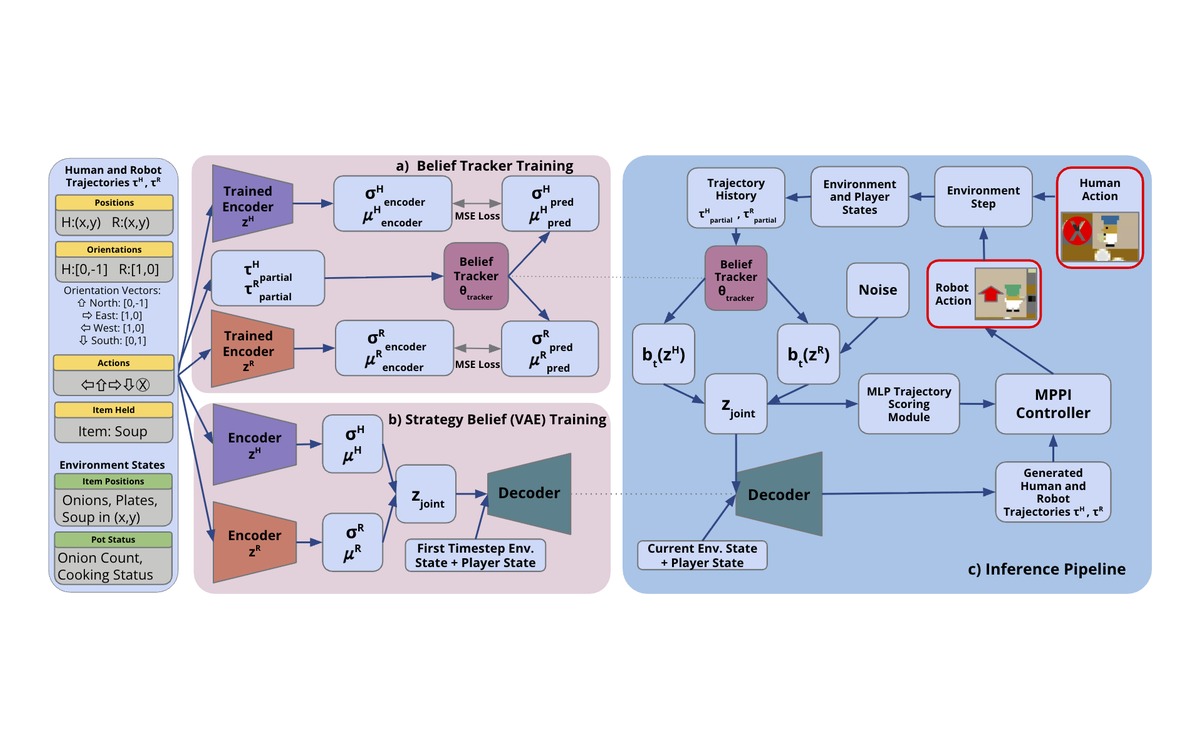
Latent Strategies for Ad-Hoc Human–Robot Teaming in Overcooked-AI
Adrian Krieger*,
Nathan Ludlow*,
Mehul Menon,
Juee Chandrachud
(*equal contribution)
Under review 2026
[abstract]
During ad-hoc human-robot teaming, autonomous robots must infer their human partner’s strategy from observed behavior and adapt without needing explicit communication. This becomes particularly challenging in complex collaborative tasks with multiple viable coordination strategies, where specialized policies can fail when partner behavior changes. We introduce a latent-strategy planning framework that represents human and robot behavior in a joint variational latent space and predicts strategy beliefs from partial interaction trajectories. The framework then samples candidate robot strategies whose decoded joint futures are evaluated online using Model Predictive Path Integral (MPPI) control. This approach couples high-level strategy inference with action selection in a single planning loop. We evaluate the approach in Overcooked-AI using 480 humanhuman trajectory pairs and compare against behavior cloning and PPO with Fictitious Co-Play. Across six human replay configurations, our method achieves the highest reward in four while avoiding the complete failures exhibited by the RL baseline when partner behavior conflicts with its learned coordination strategy. With an adaptive behavior-cloning partner, our method improves reward by 23.3-47.8% over the RL baseline across tested player positions. These results demonstrate that joint latent strategy inference combined with online trajectory optimization can improve robustness to diverse partner strategies in ad-hoc tasks.
|
|
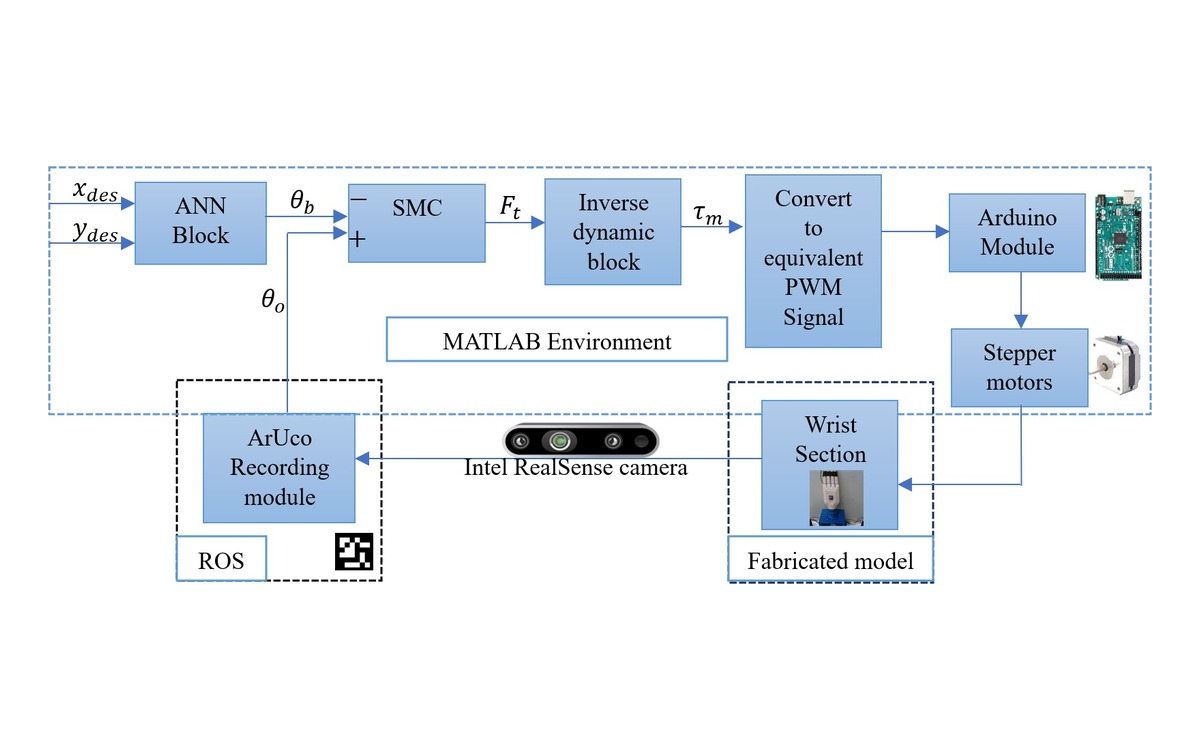
A Hybrid Model-based and Data-based Approach Developed for a Prosthetic Hand Wrist
Shifa Sulaiman, Francesco Schetter, Mehul Menon, Fanny Ficuciello
Under review 2026
arXiv
[abstract]
The incorporation of advanced control algorithms into prosthetic hands significantly enhances their ability to replicate the intricate motions of a human hand. This work introduces a model-based controller that combines an Artificial Neural Network (ANN) approach with a Sliding Mode Controller (SMC) designed for a tendon-driven soft continuum wrist integrated to a prosthetic hand known as ’PRISMA HAND II’. Our research focuses on developing a controller that provides a fast dynamic response with less computational effort during the motions of the wrist. The proposed controller consisted of an ANN for computing bending angles incorporated along with an SMC to regulate tendon forces. Kinematic and dynamic models of the wrist are formulated using Piece-wise Constant Curvature (PCC) hypothesis. The performance of the proposed controller is compared with other controller strategies developed for the same wrist. Simulation studies and experimental validations of motions of the fabricated wrist employing the controller are included in the paper.
|
|
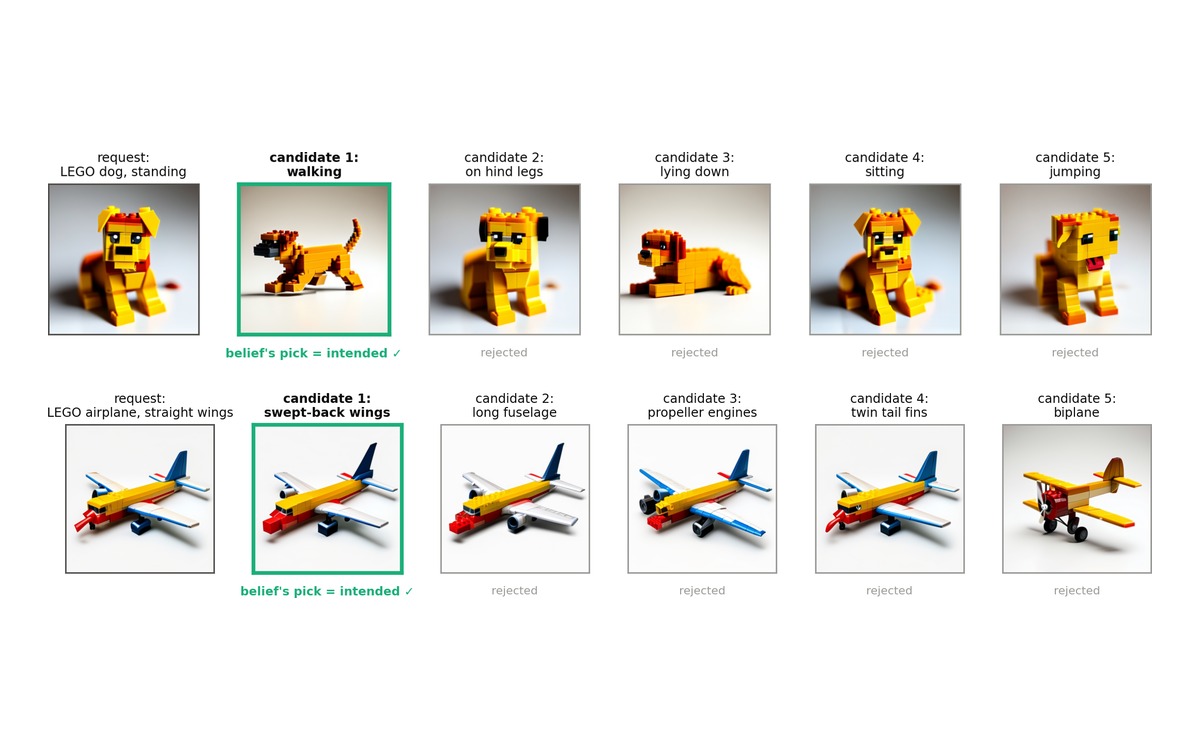
Calibrated Clarification: A Computational Maxim of Quantity for Grounding Under-Specified Human Intent
Mehul Menon,
Ruixuan Liu,
Philip Huang,
Jiaoyang Li,
Changliu Liu
IROS 2026 Workshop on Human–Robot Dialogue, 2026
paper /
workshop
[abstract]
A short prompt rarely says exactly what a person wants, yet a generative system commits to a finished result anyway, sometimes at real cost. We close that gap by clarifying interactively: the system shows two candidates, asks which one comes closer to what the person had in mind, and repeats. Done naively this fails dangerously, because the system grows confident while its guess has not moved toward the target. The scoring rule causes it. Comparing candidates by the angle between them leaves each answer nearly uninformative once the space grows large, so the system stops early having learned almost nothing. We introduce CLASP, which replaces the angle with an un-normalized closeness comparison and adds a learned low-dimensional intent basis, uncertainty-directed probing, a self-regulating update, and calibrated commit guards, which is tested on a simulated response model. Together these reach most of what such comparisons can convey in roughly 8× fewer questions. We then certify three properties of the committed result: that it covers what the person meant, that it is specific enough to act on, and that someone could realize it. Knowing when to stop proved harder, since seven candidate rules all failed to commit near a session’s best moment, so we cap the budget instead, which suffices because over-asking measurably degrades the result.
|
|
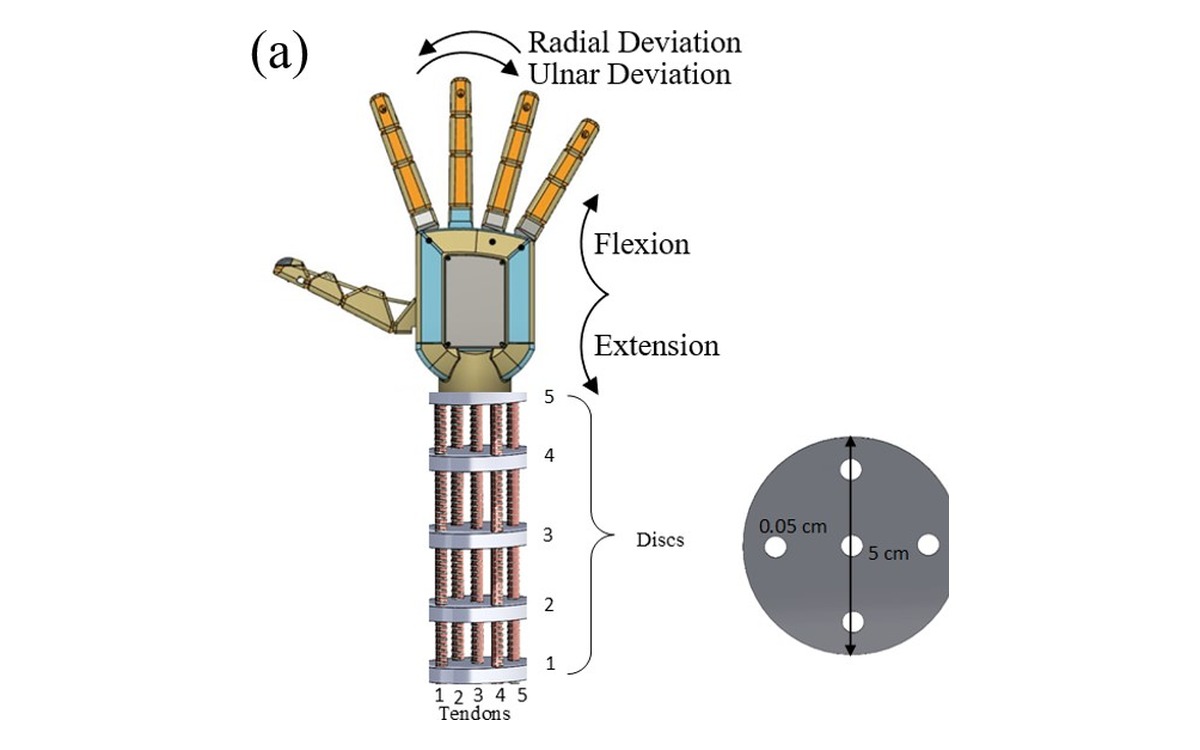
Design, Modelling, and Experimental Validation of a Soft Continuum Wrist Section Developed for a Prosthetic Hand
Shifa Sulaiman, Mehul Menon, Francesco Schetter, Fanny Ficuciello
IEEE/RSJ International Conference on Intelligent Robots and Systems (IROS), 2024
paper
[summary]
Soft continuum sections are widely used in robotics for dexterous motion, but most existing designs cannot carry a payload while moving. This paper presents a soft continuum wrist section for the PRISMA Hand II prosthetic hand that supports a substantial payload while maintaining the posture of the hand. The wrist is assembled from springs, discs, and tendons, with the number and dimensions of the springs and discs optimised through static structural analysis. Kinematic and dynamic models are derived using the Geometric Variable Strain (GVS) approach based on Cosserat rod theory and a generalised-coordinate formulation. A dynamic-model-based controller is compared against a kinematic-model PID controller, and the design and models are validated experimentally on the fabricated wrist.
|
|
Deep Learning-Based Classification of Lubricating Oils Using Ultrasonic Waveguide Sensors
Mehul Menon,
Akhil Balachandran,
Krishnan Balasubramaniam
Machinery Failure Prevention Technology Conference (MFPT), 2026
[abstract]
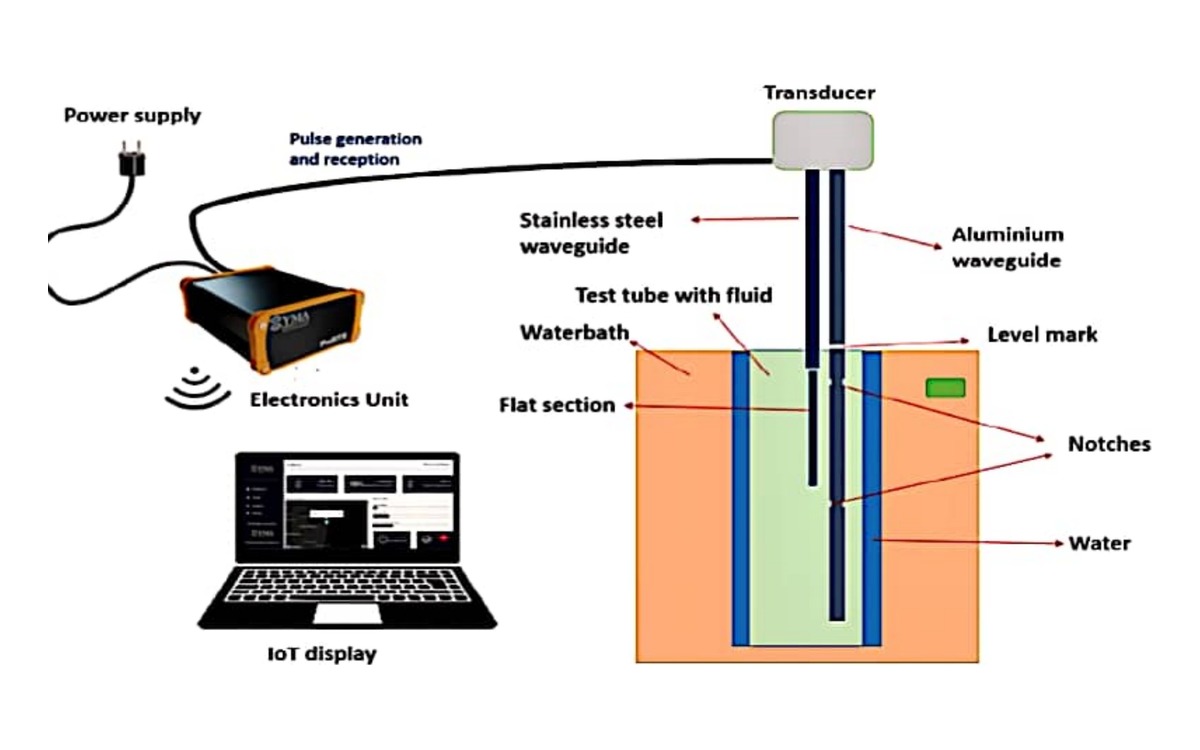
Oil condition is still assessed mostly by drawing a sample and sending it to a laboratory, so the report describes the oil as it was several days ago rather than as it is now. An ultrasonic waveguide probe can make the measurement in place on a running machine. The harder part is turning its A-Scan into an answer: the waveforms are noisy, the peaks that carry the information are easy to mis-pick, and the behaviour of the fluid under ultrasonic excitation is not simple to model. We therefore posed the problem as classification rather than inversion. Ten commercial lubricating oils were measured with a dual-material waveguide probe through a heating cycle from 30 to 80 °C, giving 198 A-Scans, and three networks were trained to name the oil from the waveform: a Transformer encoder, a multilayer perceptron fed with windowed-FFT features (FFT-ANN), and a one-dimensional convolutional neural network (1-D CNN). On held-out A-Scans the FFT-ANN scored 98.61%, averaged over five training runs, and the Transformer 97.48%; in the runs reported here both identified all ten oils correctly. The 1-D CNN reached about 92% in a typical run but collapsed to around 10% in others, for a five-run mean of 85%, and even its best run made the same error every time: every test sample of oil 6 was assigned to class 10. Separating these two oils, the closest pair in the set, means comparing reflections that lie thousands of samples apart, and the convolutional stack of this model spans only 46 of the 20,002 samples, so the comparison has to be rebuilt by the dense layers from 159 training examples. The information needed to tell these oils apart is present in a single waveform; what was missing was a model able to use it.
|
|
Adaptive Sliding Mode Control Law Based on Super Twisting Algorithm for Trajectory Tracking of Quadrotors
Biswapratim Roy, Mehul Menon, Aritro Dey, Jayati Dey
International Journal of Automation and Control, 2025
paper /
researchgate
[summary]
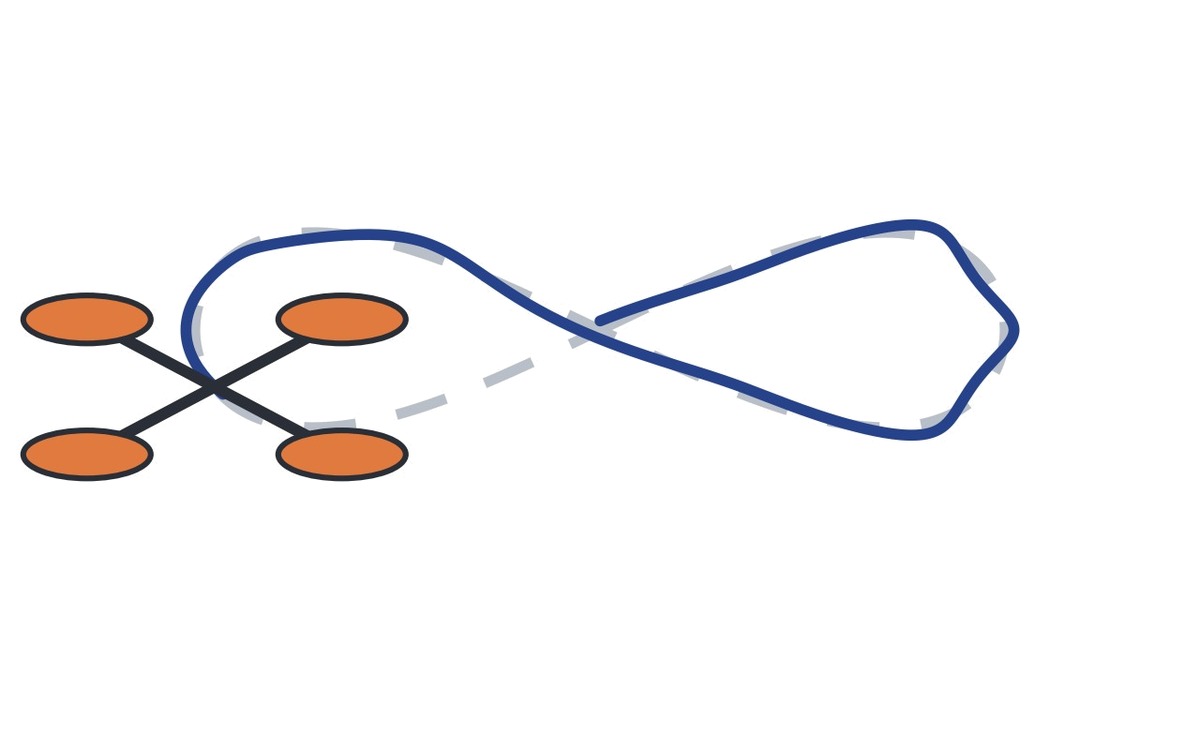
This paper proposes an adaptive sliding mode control law based on the super-twisting algorithm for robust trajectory tracking of quadrotors subject to nonlinear dynamics, actuator saturation, external disturbances, and parametric uncertainty. A PD-type sliding surface is combined with a super-twisting reaching law whose gain is adapted online, which reduces chattering and control effort relative to conventional sliding mode control. Asymptotic stability of the closed loop is established through Lyapunov analysis, and simulation results demonstrate accurate tracking of reference trajectories under disturbances.
|
|